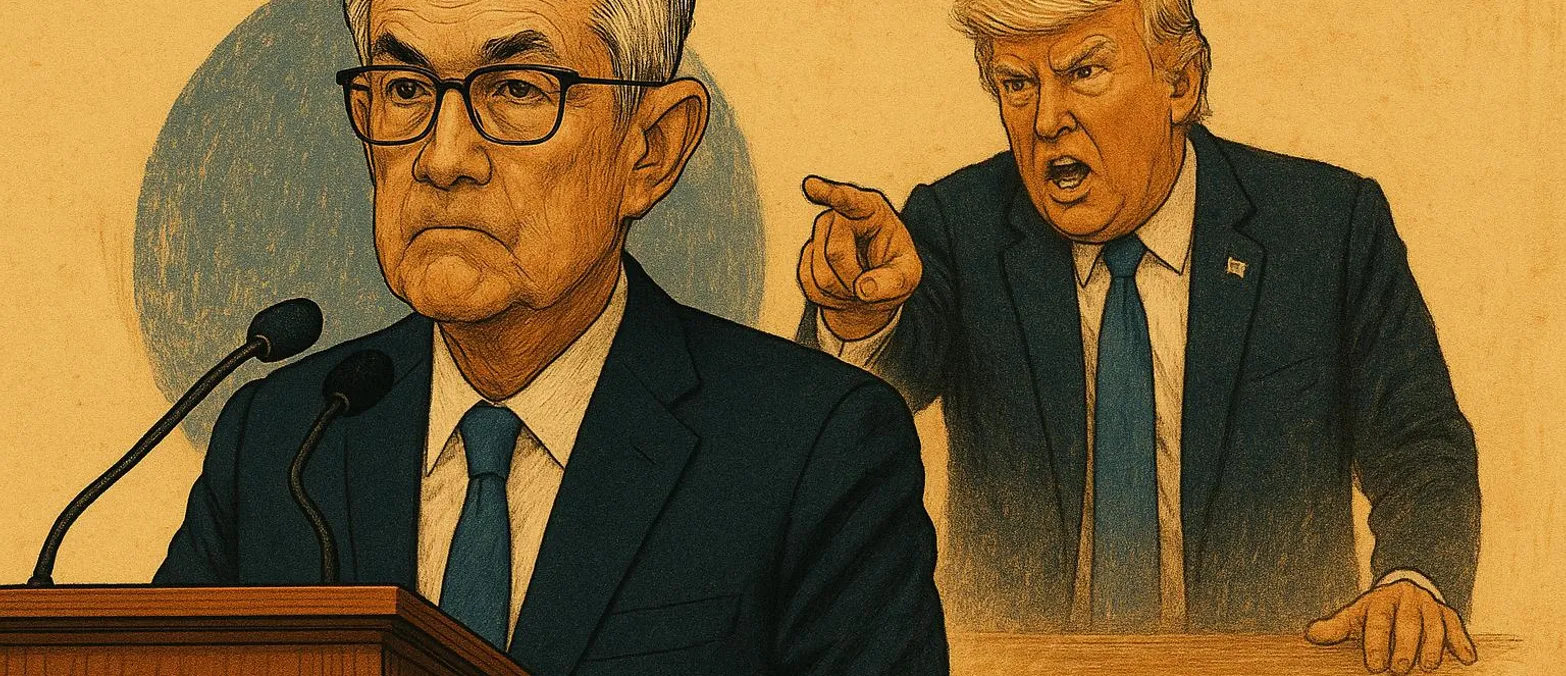
After Speech: Trump Wants to Oust Fed Chair Jerome Powell
The tensions between President Donald Trump and Federal Reserve Chairman Jerome Powell are escalating. Following a speech by the Fed Chair in which Powell openly criticized the potential consequences of Trump's trade policy on inflation and economic growth, Trump retaliated verbally and is now threatening to dismiss him. The issue at hand is not just differing views on interest rate policy but also fundamental questions of power distribution within the state. If Donald Trump were to remove Jerome Powell, it would shock the global financial markets and undermine confidence in the U.S. economy and the dollar.
• Trump Threatens to Dismiss Fed Chair Jerome Powell after Powell publicly warned about the economic consequences of Trump's tariff policy.
• Powell Criticizes That Trump's Tariffs May Short-term Fuel Inflation and potentially burden growth in the long term.
• No Quick Interest Rate Cuts Planned: Despite weaker economic prospects, the Fed remains cautious in its approach.
• Trump Attempts to Override Legal Hurdles to Remove Powell. This precedent could have drastic consequences for Bitcoin and stocks .
Trump vs. Fed Chair Jerome Powell
For Donald Trump, Jerome Powell is an obstacle on the path to economic control. The former president accuses the Fed Chair of being too hesitant with interest rate cuts, thereby hindering an economic recovery of the U.S. economy. After Powell’s widely noted speech at the Economic Club of Chicago on Wednesday, April 16, where he again warned of a potential inflation-driven economic slowdown and identified Trump's tariffs as price drivers, Trump finally lost his patience.
On his platform Truth Social, Trump wrote that the end of Powell's term "couldn’t come soon enough." During a meeting with Italy's Prime Minister Giorgia Meloni a few days ago in Rome, he reiterated: "If I want him out, he’ll be gone quickly." The message is clear: Trump seeks control over central bank policy. Powell's refusal to implement political wishes verbatim has made him a target of Trump's animosity.
Since the U.S. Federal Reserve is not an official government body, Trump does not have immediate power over the appointment of its top positions. A court proceeding could now change that and potentially initiate a constitutional paradigm shift in the U.S., which could have serious consequences for economic policy and global financial markets.
Why Can't Trump Fire Powell?
In 2017, Trump himself nominated Jerome Powell as successor to Senator and former Fed Chair Janet Yellen; a decision he later publicly regretted. When Powell positioned himself against rapid interest rate cuts, Trump began to regularly criticize him publicly. During his first term, the White House examined legal avenues to remove Powell, a step ultimately refrained from due to concerns over constitutional consequences.
Donald Trump cannot easily dismiss Jerome Powell because the Fed Chair is legally protected and the Federal Reserve is regarded as independent. However, Trump’s circle is now attempting to overturn this protection through the Supreme Court. The goal is to grant the President more power over independent agencies, including the Federal Reserve. If the court agrees, it would set a historic precedent: the independence of monetary policy would be at stake, and the markets could respond with a loss of confidence in the U.S. dollar and the entire U.S. economy.
Despite the prospect of immediate monetary easing, a Trump encroachment on the Fed would not bode well for the stock market. The U.S. economic policy's already tarnished image would suffer further, and equities might experience significant volatility in shock. Whether Bitcoin would be classified as a risky asset and sold off in such a situation or benefit as an independent store of value remains unclear.
Incidentally, the U.S. President may appoint the Federal Reserve Chair as the position is politically filled, with Senate approval. However, as mentioned earlier, removal is heavily legally restricted since the Fed should operate independently.
Jerome Powell’s Speech: Inflation and Tariffs
In his speech, Powell evaluated the U.S. economy as solid despite global uncertainty, and according to the Fed Chair, the labor market remains in very good shape. Nevertheless, he anticipates further volatility in the markets and warns of weak performance of the U.S. dollar and the economy. Regarding inflation, he noted that it might rise temporarily due to tariffs.
He does not foresee rapid or multiple interest rate cuts in the near future. ultimately arguing that the debt situation is sustainable and does not necessitate immediate monetary policy adjustments. Powell also made it clear in his speech that President Trump's recently imposed tariffs could temporarily increase inflation. The burden on consumer prices is already measurable, while long-term inflation expectations remain stable.
Therefore, extensive interest rate cuts seem more distant. The Fed views low inflation as a prerequisite for easing its interest rate policy. U.S. President Donald Trump, who accuses Powell of risking a recession with his tight monetary policy, is likely displeased with the criticism of his tariff strategy.
No Interest Rate Cuts Due to Stagflation?
In conclusion, Powell also warned that a drastic reduction in imports, as sought by the U.S. government, could lead to stagflation. This means simultaneous economic stagnation and rising prices, a scenario that caused significant issues in the 1970s.
Today, tariffs could lead to more expensive goods and services in the
U.S., while import restrictions could slow down industrial sector production processes in the medium term. Donald Trump's plan is to offset these deficits by establishing large manufacturing complexes in the U.S. However, this plan should take some time.
Despite weaker growth forecasts and increasing uncertainty, Powell gave no indication of an imminent interest rate cut. The Federal Reserve aims to continue making data-driven decisions and operate on a cautious basis. Powell reiterates his previous stance on monetary policy in his speeches. His cautious monetary policy stance and implicit warning of an economic downturn following Donald Trump's radical tariff policy were met with nervousness in the stock market.
Significant sell-offs after Powell's address led to downturns in the tech index Nasdaq and the S&P 500. Bitcoin also slightly corrected, with major altcoins, losing several percentages of market value within minutes. This is also due to poor consumer sentiment in the United States. Recently, the American Association of Individual Investors (AAII) published a survey, indicating that retail investors are currently as pessimistic about the coming months as they were during the global financial crisis of 2008.
Survey by BofA: Hedge Funds Fear
Jerome Powell also emphasized the decline in economic sentiment during his speech in Chicago. Both consumers and businesses are increasingly skeptical about the future. The trade conflict is a major economic and psychological burden. But it’s not only private individuals who are pessimistic about the economic outlook. Banks and hedge funds are increasingly reducing their risk due to weak economic prospects.
According to a recent Bank of America survey of 164 fund managers, concerns over a global economic downturn have dramatically increased. The survey was conducted between April 4 and April 10. The results: 49 percent of respondents expect a hard landing of the global economy in the next twelve months. A significant increase from eleven percent the previous month. Confidence in a soft landing dropped over the same period from 64 to 37 percent.
Why Trump Wants to Fire the Fed Chair
Following Fed Chair Jerome Powell’s critical speech on Trump’s economic policy, the U.S. President openly threatens to dismiss him, even though he nominated Powell himself in 2017. Trump accuses Powell of blocking recovery with overly high interest rate policies. As the President cannot directly dismiss the Fed Chair, his circle is attempting to overturn this legal barrier via the Supreme Court. This could endanger the independence of monetary policy and destabilize the markets. Powell’s speech warned of rising inflation due to Trump’s new tariffs, and he currently opposes interest rate cuts. Markets remain on edge.
Headlines

Consent was never given.
You need to first accept consent to see this content from TradingView.