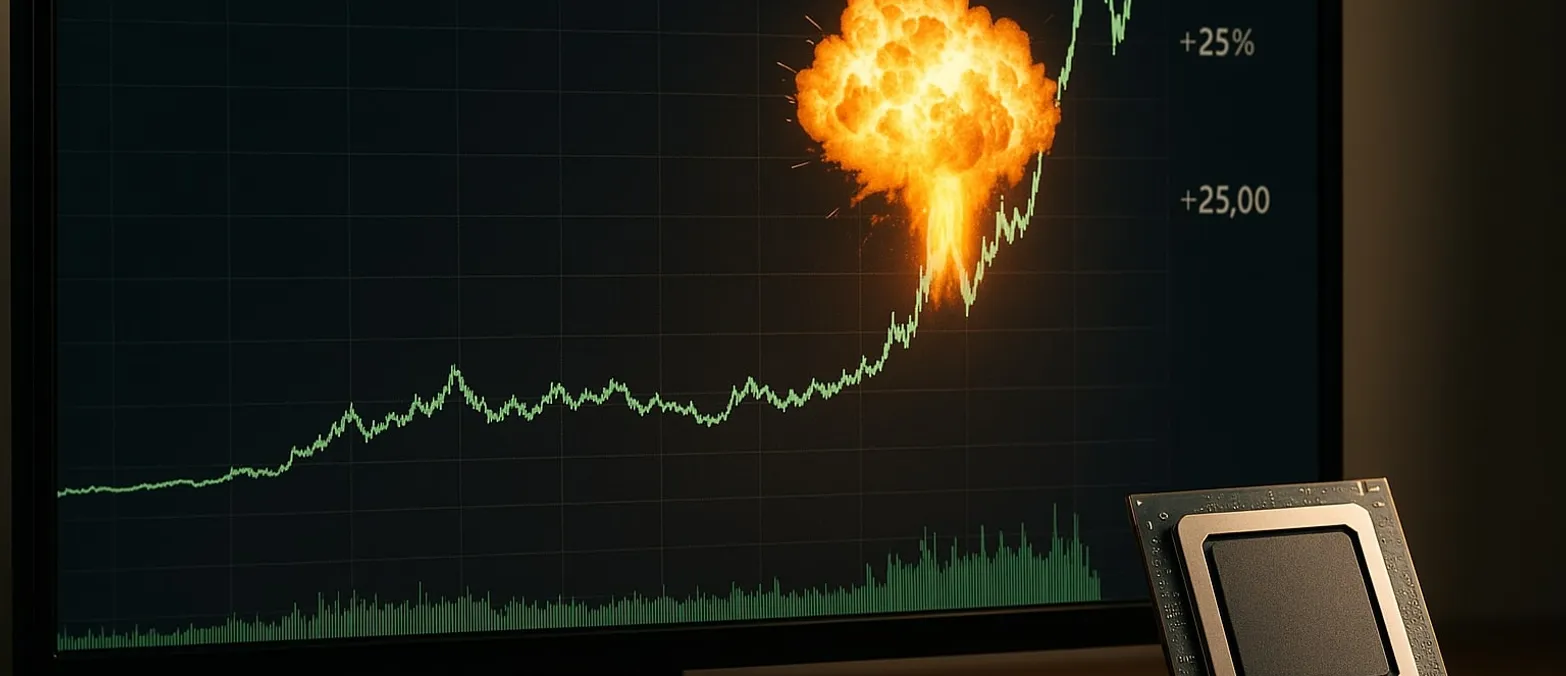
Mega Deal with OpenAI: AMD Stock Soars by 25%
AMD and OpenAI Join Forces: A Major Leap in AI Infrastructure
Chipmaker AMD has announced a landmark multi-year partnership with OpenAI to establish a massive AI infrastructure boasting six gigawatts of computing power. The ambitious project is slated to kick off in the second half of 2026, beginning with an initial phase of one gigawatt, powered by AMD's latest Instinct MI450 GPU series. Notably, OpenAI will also have the option to purchase up to 160 million AMD shares at a nominal price of $0.01 per share.
Strategic Partnership with Significant Implications
AMD secures one of the largest deals in its history in collaboration with AI innovator OpenAI, renowned for ChatGPT. Together, they plan to develop a supercomputing infrastructure for artificial intelligence with six gigawatts of computing power. This scale matches the largest cloud and data centers globally. AMD will supply specialized Instinct GPUs, optimized for training and running AI models. OpenAI officially recognized AMD as a "strategic core partner for computing power" in their announcement.
Technical Timeline: Launch Set for 2026
The infrastructure development will occur in phases, starting with a 1-gigawatt installation expected to go live in the second half of 2026. This phase will utilize the new AMD Instinct MI450 series, succeeding the current MI300X and MI350X chips. These high-performance processors are designed to handle vast data sets simultaneously, crucial for training large language models like GPT or image-based AI.
It's key to understand that when AMD mentions "one gigawatt," they refer to the energy requirement of the entire planned facility, not the individual processor's output. For context, a modern data center from major cloud providers typically ranks between 100 and 300 megawatts.
A one-gigawatt facility would rank among the largest globally. Considering that each high-performance graphics chip uses roughly 700 to 1,000 watts, OpenAI would need approximately a million GPUs for this initial stage—demonstrating the project's massive scale. As the collaboration progresses, the computing capacity will extend to a total of six gigawatts, spread across various chip generations and locations.
OpenAI's Stake: 160 Million Stock Options
The deal's financial structure has drawn significant attention. OpenAI receives warrants, enabling them to purchase AMD shares at a predetermined price in the future—up to 160 million shares at the symbolic price of $0.01 per share. These options are valid only if OpenAI hits specific technical and economic milestones.
According to Handelsblatt, if successful, OpenAI could potentially acquire up to around ten percent of AMD's shares. Such equity models are rare in the tech sector, highlighting the close partnership both companies aim to cultivate.
Potential Multi-Billion Dollar Revenue and Profit Impact
AMD expects the partnership with OpenAI to generate revenues in the tens of billions over the coming years. CFO Jean Hu stated that the deal would significantly boost earnings per share, meaning that AMD will profit more per share from the agreement—a factor that excites investors. Beyond chip supply, AMD will also be involved in the integration and optimization of systems.
The agreement spans several years and covers hundreds of thousands of processors. It is expected to solidify AMD's position as the second-largest provider behind Nvidia. The announcement sent AMD's stock soaring by over 25%. Analysts consider this a major milestone, as AMD has often been in Nvidia's shadow.
Now, the partnership with OpenAI signals that AMD is becoming a formidable player in the global AI data center arena. AMD executive Forrest Norrod called this a "turning point for the company," suggesting that gaining the trust of a leader like OpenAI could attract other significant customers down the road.
Voices from Both Sides
In official statements, both parties praised the importance of their collaboration. AMD CEO Lisa Su described it as a "win-win partnership" that accelerates the development of high-performance AI systems worldwide. OpenAI CEO Sam Altman stated that AMD's graphics processors will help provide the enormous computing capacities needed for advanced AI applications. Co-founder Greg Brockman highlighted the "close collaboration across all levels of the stack," from hardware to software.
To frame it: A computing capacity of six gigawatts is comparable to the output of several large power plants. This number emphasizes the scale required for today's AI operations. The new infrastructure is intended to help OpenAI train its models faster, and operate more reliably and scalably on a global scale. Simultaneously, this order strengthens AMD's position in a market driven by the demand for energy-efficient yet extremely powerful chips.
Looking Forward: The Next AI Boom is on the Horizon
The initiation of the first phase in 2026 marks the start of a long-term expansion. With each additional phase, AMD anticipates increased revenues while OpenAI can expand its capacity for new AI products. Industry experts predict that this partnership could trigger a new wave of investment in AI data centers. For AMD, this mega-deal represents not only a financial leap but also the opportunity to establish itself as a worthy competitor to Nvidia.
Author
Headlines

Consent was never given.
You need to first accept consent to see this content from TradingView.