"Panic Attack": Is BYD Disrupting China's EV Industry?
The Battle for the Chinese EV Throne: BYD's Price War and Market Shifts
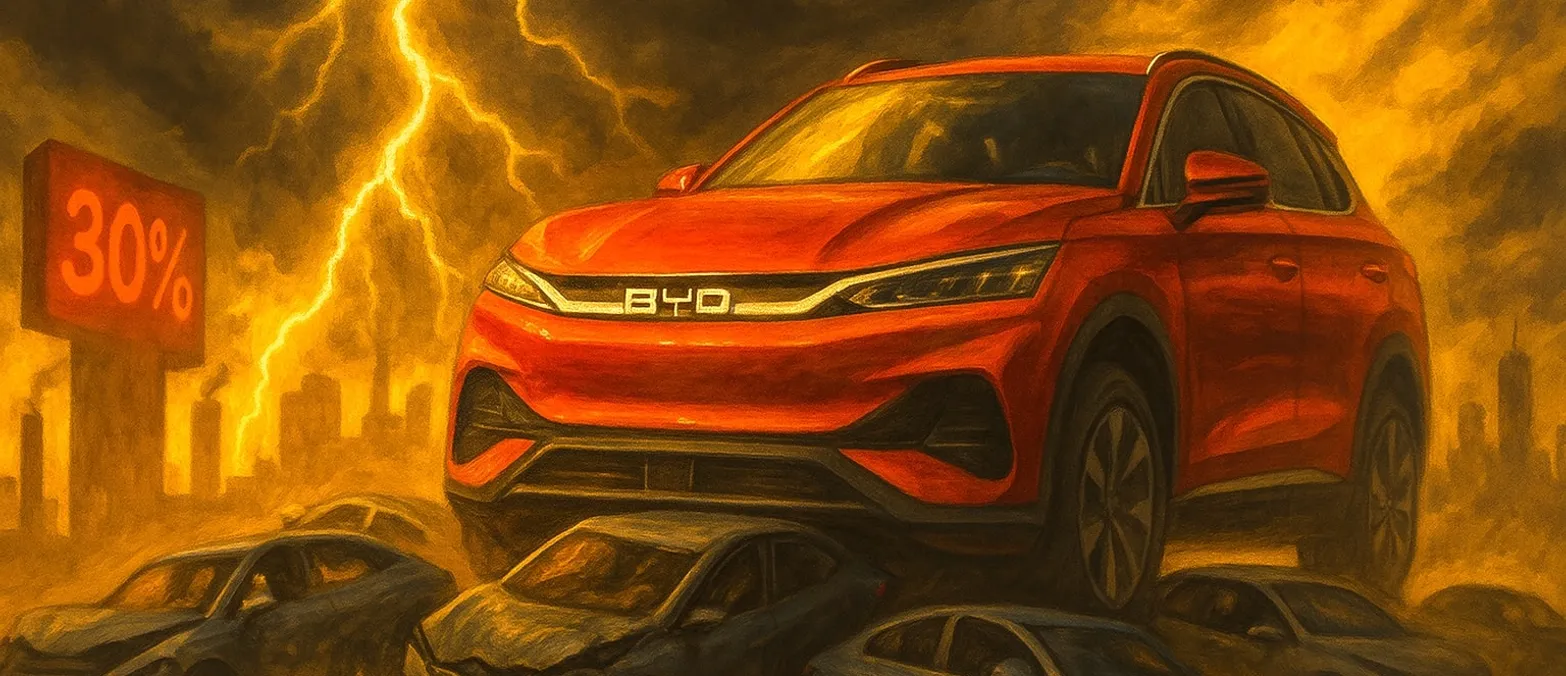
Last year, He Xiaopeng, CEO of automaker XPeng, warned of a "bloodbath among Chinese automakers." It seems his prediction is manifesting. Excessive production capacity clashes with fierce competition and aggressive price slashing. At the center of this is market leader BYD, which surpassed Tesla just 18 months ago. BYD has ignited a new price war, offering discounts up to 30%, unsettling not just Chinese competitors.
Critics have dubbed this the "Evergrande of the automotive industry," drawing parallels to the Chinese real estate giant's collapse that shook China’s property market in 2021. Companies like Nio face dwindling demand, while XPeng is betting on risky foreign expansion. What lies ahead for China’s showcase industry?
BYD Fuels the Price War
Despite a strong performance last year, the Chinese EV sector struggles against relentless competition spurred by new startups. Chinese manufacturers are engaged in price wars, accelerating a downward spiral. In May 2025, BYD intensified the price battle by cutting prices up to 30% on 22 models, sparking speculation about their ability to sustain such pricing strategies. Rumors suggest BYD is scaling back production at several plants to save costs, prompting comparisons to a panic-stricken response where market leaders offload their vehicles below value, forcing smaller manufacturers out.
Even China's state-owned publication Renmin Ribao criticized BYD's strategy, calling it a "chaotic price war" that endangers the supply chain. The Chinese transport ministry echoed concerns stating, "Price wars have no winners — and no future." The anxiety surrounding what is considered a hallmark sector of China reaches the highest political echelons.
No resolution is forthcoming. Despite fierce competition, the EV market remains lucrative for well-financed new entrants. In March, Xiaomi, now also active in the EV market, raised about $5.5 billion through stock sales in Hong Kong to fuel a new AI and electric mobility offensive.
The Root of BYD's Aggressive Pricing
China’s projected production capacity for electric vehicles by 2025 is estimated at 36 million units, against a demand of only 14 million. This results in an oversupply of over 20 million units, exceeding Europe’s total annual output. BYD attempts to maintain production volumes through price cuts to support scaling efficiencies and bolster export ambitions. However, industry observers warn this strategy might cause a collapse, with some automakers seemingly burn through capital just to gain market share.
BYD defends its strategy as essential for survival. While considered stable, the company carries significant debt, reportedly nearly 75% leverage, with concerns about additional hidden liabilities, including a report from GMT alleging concealed debts of $44 billion.
Nio's Fight Against Recession
Nio, once a hopeful market leader, faces structural challenges and has endured persistent losses despite ambitious plans. Unlike BYD, Nio targets a premium segment which demands high research investment and lower volume. However, demand weakens, as high prices and economic uncertainty hit China's middle class, with Nio's ambitious plans for battery swap stations and proprietary chips garnering skepticism.
While Nio increased deliveries by 40% year-on-year to 42,000 vehicles in Q2 2025, losses amplify. Moreover, Nio struggles to penetrate export markets, unlike rivals BYD and XPeng who actively expand elsewhere. Nio's unique technologies, like autonomous driving advancements, are promising but fail to offset the lack of scale, with Nio dropping prices for its Firefly brand due to competitive pressures.
XPeng's Global Ambitions
XPeng, meanwhile, focuses on international expansion, announcing plans to enter over 60 countries. With more than 300 new service and marketing locations, XPeng aims to be among the top three Chinese auto exporters by 2027, with foreign revenue comprising half of its sales. This ambitious initiative begins in Australia with the launch of the P7+ at the Melbourne International EV Show, showcasing advanced Qualcomm technology.
XPeng emphasizes ethical export practices, steering clear of dubious strategies like selling 'zero-mile used cars.' Analysts commend XPeng’s competitive vehicle offerings with superior autonomous features. Financial indicators are also favorable, as Nio records gross margins rising to a multi-year high of 10%.
Should U.S. Investors Consider Chinese EV Stocks?
The Chinese EV sector divides investors remarkably. Those invested here have been through challenging times, except for BYD, which recently saw new highs. Both Nio and XPeng struggle with persistent market Sell-offs. Geely holds up better but remains far below its 2021 peak. Current uncertainties from overproduction, tepid demand, and a relentless price war initiated by BYD cloud near-term recovery prospects, particularly for smaller manufacturers.
Nonetheless, dismissing China's EV sector might be premature. BYD managed to double its market value between mid-January and May. Geely rebounded swiftly following negative sentiment from U.S. tariff announcements in April, gaining 60% by May's end. Despite temporary corrections, long-term profit potentials remain robust.
The sector could benefit from ongoing Chinese government stimulus and subsidy programs, alongside recently announced tech initiatives targeting domestic knowledge consolidation, potentially enhancing the market's attractiveness. Revenue growth is further anticipated in new business ventures Chinese EV giants are exploring, from custom chips to AI and robotics. The price war rages, but these fighters are resilient and innovative.
FAQ BYD:
What Does BYD Stand For?
BYD stands for "Build Your Dreams," embodying their mission to lead the transition to zero-emission mobility worldwide, starting from China.
What's the Cheapest BYD Model?
The lowest-priced BYD vehicle costs roughly $10,000 in China, with prices likely decreasing further. This is facilitated by aggressive discounts aiming to secure market share, sideline competition, and leverage operational scales.
Is BYD a Reliable Car?
While technologically solid, especially relative to its price class, BYD is critiqued for sacrificing quality in pursuit of low pricing. Nevertheless, BYD is gaining trust and ascent beyond being a low-cost brand, into a viable Tesla competitor with global aspirations.
Who's Behind BYD?
BYD Company Limited, initially a battery manufacturer, rapidly ascended to become the leading global EV producer and a formidable competitor to Tesla, supported by strong political backing from Beijing.
Headlines

Consent was never given.
You need to first accept consent to see this content from TradingView.