Tesla Sales Fall Significantly: DOGE Authority without Musk?
Shortly before the presentation of the quarterly figures, Tesla released their sales for the past three months on Wednesday. There had already been speculation about a significant decline, and recently analysts had progressively slashed their forecasts. Yet, the former electric car shooting star disappointed across the board: Tesla delivered a hefty 13 percent fewer vehicles compared to last spring to customers, falling even below the most cautious expectations. The decline was particularly drastic in China and Europe. Elon Musk's political escapades likely played an important role here. When it was also announced on Wednesday that Musk might leave his DOGE agency, Tesla shares experienced a small recovery rally.
"Epic" Year Starts Rocky
Elon Musk made many promises over the past months. When Tesla recorded the largest sales decline in over ten years in spring, the billionaire explained that they were merely between two growth waves—soon they would see green figures again. However, Tesla didn't shake off these apparent growing pains as promptly as hoped: In the second quarter of the previous year, profits plunged by more than 40 percent, and in the fourth, even by 70 percent. Although 2024 closed with a record in sales, the general expectations were not met. Trump's trade policies, which are now targeting the automotive sector, provide little help. Musk's political involvement is also increasingly unfavorable among Tesla's clientele.
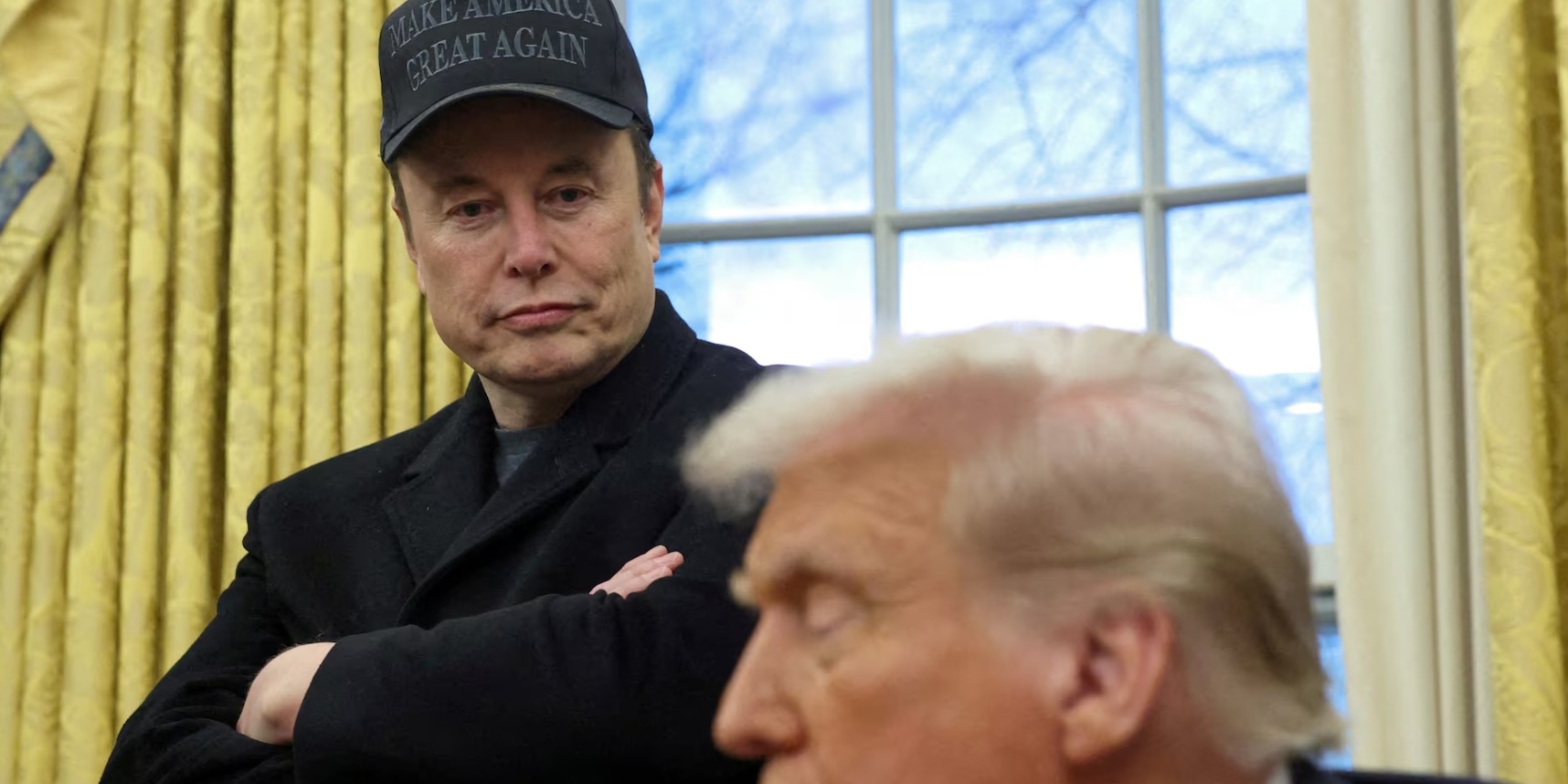 Pretty good friends for a time? Trump's policies are troubling Tesla. Now, Musk wants to withdraw from the Department of Government Efficiency.
After the initial Trump euphoria, which primarily led to a bullish year-end for tech stocks, Tesla shares have been harshly punished recently. More than half of the market value was lost, turning Tesla from a shooting star into an underperformer of the Magnificent Seven including Apple, Microsoft, Meta, and others. Even at the presentation of the most recent financial figures for the previous quarter, Musk confidently promised that the coming years would be "epic" and "ridiculously good." However, the start of this triumphant march declared by Musk has so far been rocky.
Strongest Sales Decline in Tesla History
Between October and December, Tesla set a new annual record with over 495.000 vehicles delivered, but narrowly missed the general expectation of at least 500.000 deliveries. And the dry spell continues: As Tesla announced on Wednesday before the U.S. market opened, it sold nearly 337,000 cars in the first quarter, about 13 percent less than in the same period of the previous year.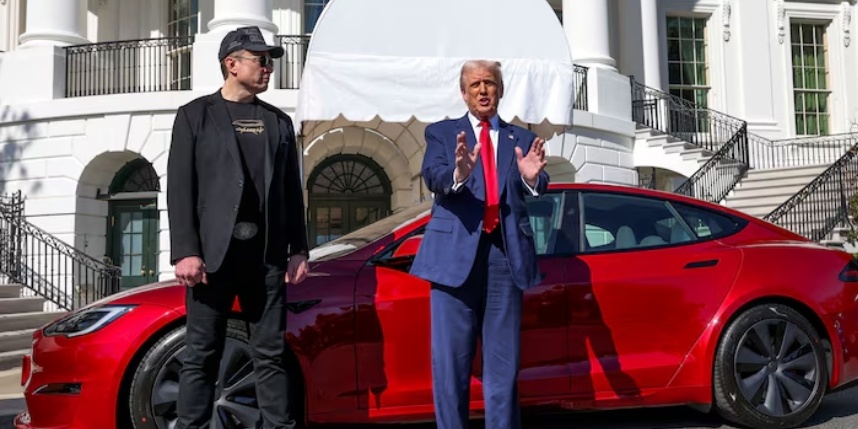 A few weeks ago, Trump hosted a sort of Tesla sales show in front of the White House. Not even that could save first-quarter sales.
Back then, 387,000 Tesla models found new owners. The stock market continues to take a hard stance with Tesla: Within the first 15 minutes after market opening on Wednesday, Tesla shares already fell by a good six percent. This disappointment is likely caused not only by Tesla now officially showing the strongest sales decline since its founding, but also because the results fall short compared to broad market expectations.
Analysts had repeatedly lowered their sales forecasts for Tesla recently, accounting for the challenging market situation in the competition with China—Musk referred to it a few weeks ago as a kind of "hangover." For example, Deutsche Bank just last week lowered its expectation from 350,000 to 340,000 vehicles, while the consensus among major banks and brokers in January was 450,000. By the end of March, this average forecast had shrunk to just under 378,000 cars—Tesla fell short of even this revised benchmark.
Musk Likely Leaves DOGE – Tesla Rises
The numbers weigh particularly heavily due to declines in important markets like Europe and China. In January and February alone, Tesla sales declined by an alarming 49 percent, according to the European Association of Automobile Manufacturers. The fact that cross-brand electric car sales in Europe increased by more than a quarter at the same time makes the situation particularly bitter: Tesla seems to be getting increasingly smaller slices of the growing pie. The situation is similar in China: The entire electric vehicle market in Tesla's second most essential sales market (after the U.S.) recently grew by a notable 39 percent. Tesla's own sales in China fell by 11.5 percent in March alone to below 80,000 vehicles.
How much Musk's political role also polarizes on the stock exchange was evident on Wednesday: Shortly after the lackluster sales figures became known, the rumor emerged that Musk would withdraw from his Department of Government Efficiency (DOGE). The rumor is said to have originated from Trump's inner circle. The Tesla share promptly made a steep upward jump, quickly offsetting the sell-off resulting from the negative sales figures. The stock market could hardly have signaled more clearly how great the uncertainty about Musk's image transformation and his political adventures in Trump's orbit is.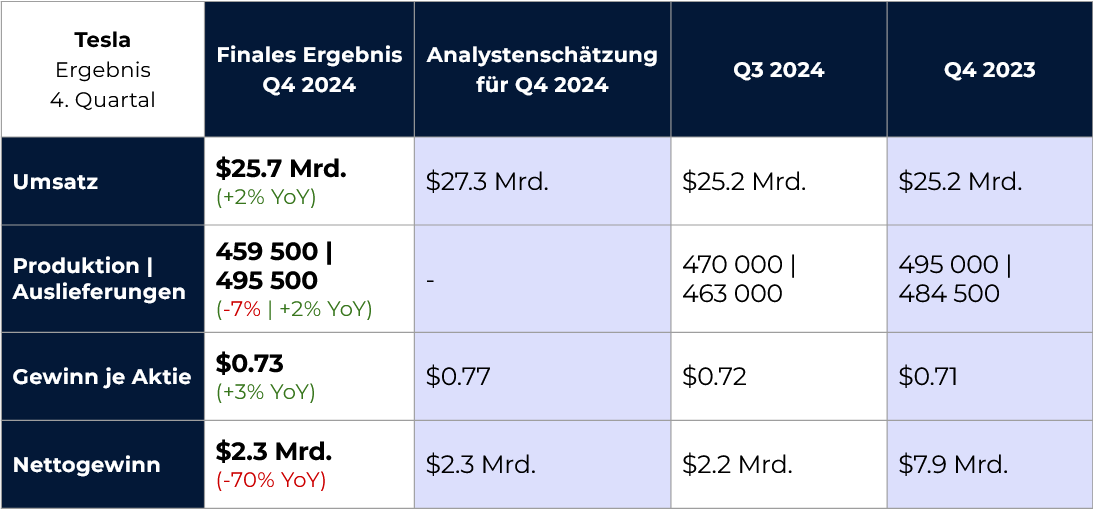 In the past fourth quarter, Tesla's sales slightly increased but remained below expectations. Net profit dropped dramatically.
In Europe, critics primarily blame Elon Musk for burdening Tesla's image with his ongoing advertising campaign for Donald Trump. Additionally, Tesla is pressured by Trump's tariffs, which mostly affect vehicles and parts from China, Canada, and Europe. Internal problems are also responsible for the noticeable decline in sales figures. Tesla recently had to halt the production of its bestseller Model Y for several weeks to transition to the new generation of the car. In January, it became known that Tesla would release the Model Y as a completely revamped facelift.
In addition to technical details, the design is also changing. It's hardly surprising that demand for the old Y models is weaker now, while the new ones are still in production. The next opportunity for Musk and Tesla to make up for the disappointment of recent sales figures comes on April 23. That's when the company will present its business figures for the first quarter. In the previous fourth quarter, Tesla recorded a revenue of $25.7 billion, marking a modest two percent increase—significantly below analysts' estimates of $27.3 billion. Earnings per share climbed three percent to $0.73, also missing the forecast of $0.77.
For those who can't get enough of Tesla analysis, take a look at our new AI package. In addition to Elon Musk's electric car giant, it also features the most exciting companies related to artificial intelligence. U.S. giants like Nvidia and Apple are represented, as well as German contender Süss Microtech or market exotics like Intuitive Surgical and Spotify. For a limited time, you can get a 20 percent discount on the new AI stock package with the code RedPill20. Since some stocks in the new AI package overlap with those in the existing TECH33, US-Titans, and China-Titans, we offer customers of one or more of these three packages an additional 15 percent discount on the AI stock package.
Headlines

Consent was never given.
You need to first accept consent to see this content from TradingView.